Too Many Manual Steps
Data is scattered across spreadsheets, business applications, and standalone reports, making it difficult to obtain a reliable, unified view.
Automated Reporting
I automate the collection, transformation, and consolidation of data from Excel, business system, and other compatible sources, reducing manual work, errors and relieance on processes that are difficult to mantain.
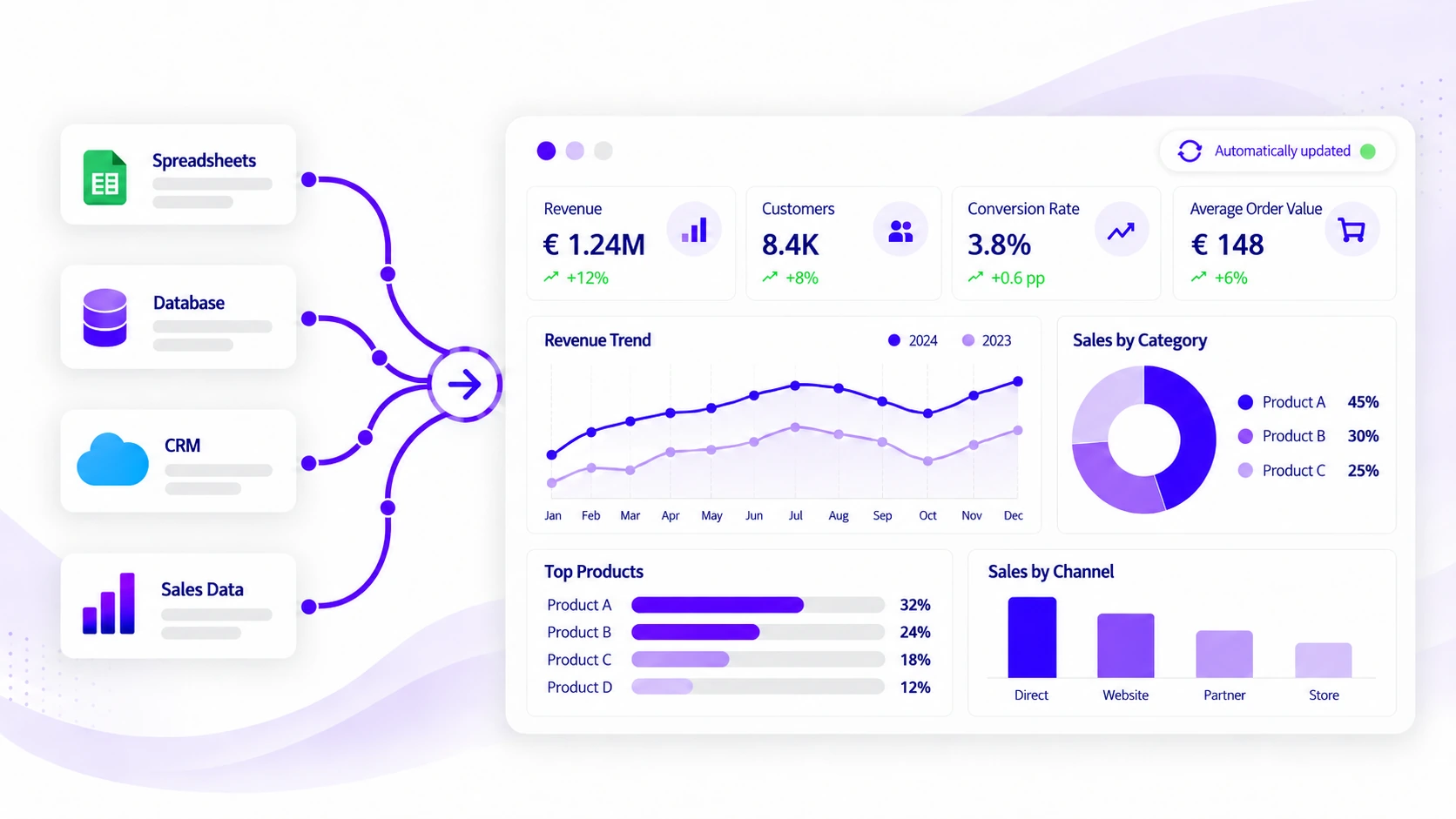
Example of an automated consolidated report
The Hidden Cost of Reporting
Excel files, business systems, CRM platforms, and other sources generate data every day. The real cost appears when collection, checks, transformations and consolidation have to be repeated every time the report is update.
Data is scattered across spreadsheets, business applications, and standalone reports, making it difficult to obtain a reliable, unified view.
Manual copying, formulas, and repetitive operations can introduce inconsistencies that are difficult to identify before reports are delivered.
Business insights become available only after issues have already emerged, leaving less time to take corrective action.
When reporting rules, files, and procedures are known by only one person, any absence or organizational change makes the process fragile and difficult to maintain.
An effective reporting process must be consistently repeatable, not rebuilt from scratch every time.
A More Efficient Process
Every reporting workflow is designed to deliver reliable insights through an automated and repeatable process.
Imports, data cleansing, copying, and recurring updates are structured to minimize operational workload.
Centralized business rules and controlled workflows reduce inconsistent formulas, conflicting versions, and accidental changes.
Data from multiple files and business systems is consolidated into a single, consistent reporting dataset.
Calculations, classifications, and aggregation logic are applied consistently with every refresh.
Reports can be regenerated through a standardized workflow without rebuilding the entire process each time.
Time saved on operational tasks can be dedicated to validating results, investigating anomalies, and supporting better decisions.
What You Can Automate
Every report follows specific data sources, business rules, validation checks, and update schedules. The automation is designed around the real process you use today to collect, transform, and distribute business information.
Area 01
Automate the collection and consolidation of sales data from CRM systems, ERP platforms, and Excel.
Area 02
Automate the generation of financial reports while reducing manual work and repetitive validation tasks.
Area 03
Centralize production and logistics data to generate regularly updated operational reports.
Area 04
Measure the effectiveness of customer acquisition activities and the real business impact of marketing campaigns.
Area 05
Automate executive reports, ensuring consistent and up-to-date data with every reporting cycle.
Area 06
Every reporting workflow is tailored to your data sources, refresh frequency, and operational requirements.
What's Included
The project includes everything required to deliver a solution that is understandable, reliable, and practical for day-to-day business operations.
Analysis of data sources, workflows, responsibilities, validation steps, and operational bottlenecks.
Identification of files, exports, databases, and update mechanisms.
Integration of data from multiple sources into a unified dataset.
Standardization of formats, codes, and business rules.
Configuraation of recurring operations that can be standardized and automated.
Creation of new reports or redesign of existing reporting outputs.
Validation checks, rule traceability, and operational documentation.
Solution delivery, onboarding session, and initial support.
Why It's Tailored
Two companies may collect similar data while requiring completely different decision-making insights. That's why every reporting solution is designed around your operational workflows, data sources, and the way information is generated and distributed.
The outcome is more than just a faster report: it's a more robust and sustainable reporting process.
I don't force your business into a standard template. The solution is designed around what you need to monitor, measure, and improve.
Every step of the reporting workflow is documented, traceable, and easy to validate.
New data sources, KPIs, and business requirements can be incorporated over time without rebuilding the solution.
The Right Solution
Automated reporting delivers the greatest value when your process requires recurring updates, reliable data, and reduced manual effort.
Not sure whether this is the right solution? During our initial consultation, we'll assess your current process and determine whether reporting automation is the best fit for your needs.
Frequently Asked Questions
Answers to the most common questions about reporting automation, data source integration, and automated report refreshes.
Yes. Existing Excel files can be used as a data source, provided their structure, data quality, and update process support the required outcome. Any limitations will be assessed during the initial review.
It depends on the ERP platform, available access methods, and licensing model. Direct connections, databases, structured exports, or other compatible integration approaches can be evaluated.
Yes, whenever the data sources and technical environment allow it. The refresh frequency and level of automation depend on data access, the technologies involved, and the available infrastructure.
It depends on the number of data sources, workflow complexity, data quality, and required validation logic. After the initial assessment, you'll receive a project estimate based on your actual reporting process.
Absolutely. Excel can remain a data source, a validation layer, or the final reporting output. The goal isn't necessarily to replace Excel, but to eliminate fragile and repetitive manual work.
Yes. The solution can be designed to progressively integrate new data sources, KPIs, report pages, and users while maintaining a consistent, scalable, and easy-to-manage architecture.
Want to see some completed projects? View Selected Projects →
Less Manual Work
If every reporting cycle still depends on copying data, exports, and manual validation, we can transform your reporting into a faster, more reliable, and easier-to-maintain process.
Together we'll assess your current process, available data sources, and reporting objectives to identify the solution that best fits your business.